


Introduction
A very long word list can look useful. However, it may not prepare you well. Inburgering A2 vocabulary focuses mainly on common daily situations.
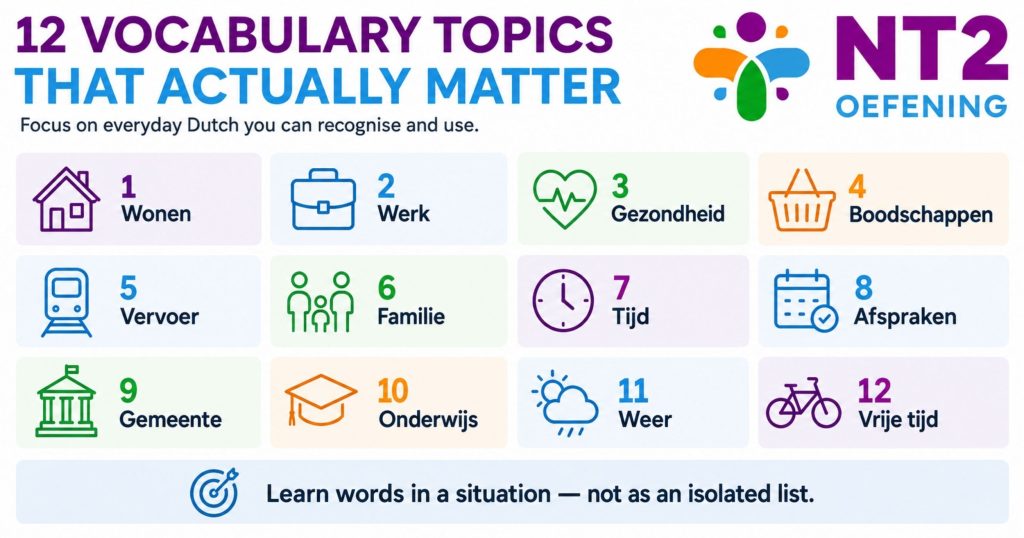
You need words for housing, work, health, appointments, travel, and contact. Therefore, learn words in practical topic groups.
This guide explains twelve high-value topics. It also shows how to remember and actively use each word.
Read the previous guide: Inburgering A2 Reading: The Fast Skim and Scan Strategy
Topics 1–3: personal life, family, and housing
- Personal details: naam, adres, geboortedatum, nationaliteit, telefoonnummer, getrouwd, and alleenstaand. Practice complete questions and answers.
- Family and contacts: partner, ouders, kinderen, buurman, vriendin, bezoeken, bellen, and helpen. Connect relationships with actions.
- Housing: huis, kamer, huur, sleutel, verwarming, kapot, verhuizen, and repareren. Combine problems with polite requests.
These topics often appear together. For example, a municipality asks for personal details. On the other hand, a landlord asks about a housing problem.
Topics 4–6: work, school, and health
- Work: baan, collega, baas, salaris, pauze, rooster, solliciteren, ziekmelden, and werken.
- School: les, docent, huiswerk, toets, boek, oefenen, begrijpen, and uitleggen. Add polite questions.
- Health: huisarts, apotheek, afspraak, pijn, koorts, hoesten, medicijn, and beter. Connect body parts with symptoms.
These topics require clear actions. You may need to call, cancel, explain, or request help. Therefore, learn verbs with matching nouns.

Topics 7–9: shopping, transport, and authorities
- Shopping and money: winkel, prijs, korting, maat, bon, pinnen, contant, ruilen, and betalen.
- Transport: bus, trein, halte, station, kaartje, vertraging, vertrekken, overstappen, and aankomen.
- Authorities: gemeente, formulier, afspraak, loket, paspoort, brief, aanvragen, meenemen, and ondertekenen.
Exam texts may combine these fields. For example, you travel to a municipality appointment. So, practice mixed situations, not isolated lists.
TimTopics 10–12: free time, weather, and communication
- Free time: wandelen, fietsen, zwemmen, club, wedstrijd, weekend, and afspreken.
- Weather and clothing: regen, wind, koud, warm, jas, schoenen, aantrekken, and meenemen.
- Communication and technology: e-mail, bericht, website, wachtwoord, computer, sturen, openen, and downloaden.
Use every noun with an action. Do not learn only regen. Say: Het regent, dus ik neem een jas mee.
The best method for A2 words
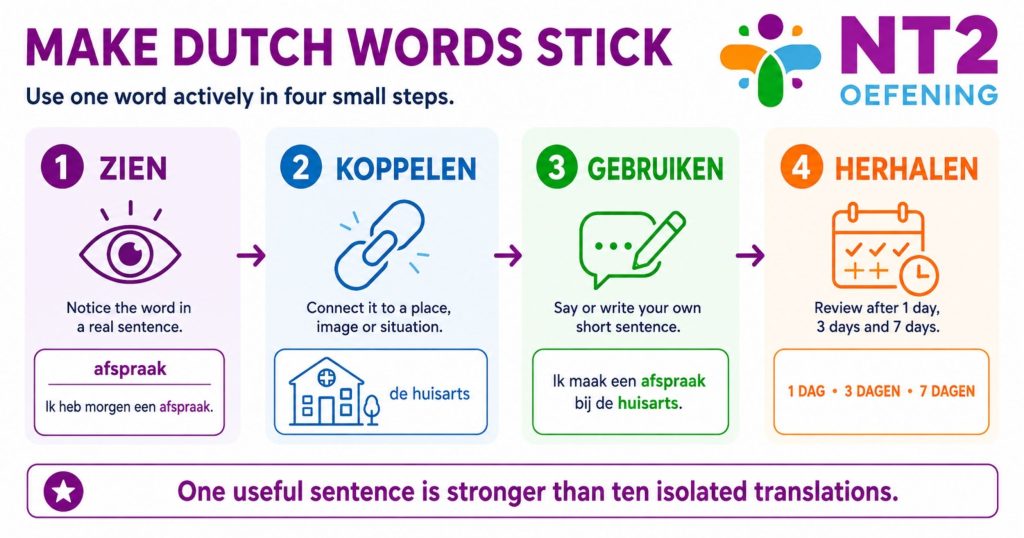
Create one card for a situation, not one isolated translation. Put a useful Dutch sentence on the back.
Use spaced review. Study today, tomorrow, after three days, and after one week. Then, mix old and new topics.
Produce language daily. Write five sentences and speak five sentences with the same target words.
Use words in real tasks. NT2 Oefening combines vocabulary with reading, listening, writing, and speaking. Progress results show which topics need more work.

A weekly vocabulary routine
- On Monday, study personal details and housing.
- On Tuesday, review work and school.
- On Wednesday, practice health and appointments.
- On Thursday, combine shopping and transport.
- On Friday, use authorities and technology.
- On Saturday, complete a mixed mini-test.
- Keep Sunday light. Review only difficult cards and listen to a short dialogue. Therefore, your brain receives useful recovery time.
- Also, track active recall, not simple recognition. A word counts as strong when you can hear, read, write, and say it.
A practice checklist
- Set one clear goal before each Inburgering A2 vocabulary session. A precise goal improves focus and makes progress measurable.
- Work under gentle time limits. First, protect accuracy. Then, reduce the time in small steps.
- Also, write down every repeated error. Add the reason and one correct example. Review it after three days.
- Use Dutch during active practice. Translate only when a word blocks the main meaning.
- On the other hand, mix focused drills with realistic tasks. Drills repair one weakness. Full tasks test whether the skill transfers.
- End each week with a short review. Compare accuracy, speed, confidence, and error patterns.
- Keep study sessions regular. Twenty focused minutes often helps more than irregular long sessions.
- Use reliable exam information. Check your personal requirements in Mijn Inburgering and use official DUO materials.
- During Inburgering A2 vocabulary practice, check the task before choosing your method. Then, complete the task without stopping. Finally, review both the result and the process.
- Regular Inburgering A2 vocabulary training should connect exam technique with real daily communication. This balance builds useful Dutch and steadier exam performance.
- Keep your materials simple and consistent. Use one error notebook, one progress record, and trusted practice sources. Therefore, you can see patterns clearly. Moreover, you avoid wasting time between different systems.
Conclusion
A strong Inburgering A2 vocabulary approach uses clear steps, regular practice, and honest error review. Therefore, focus on useful daily Dutch and repeatable exam techniques. Use official DUO material for orientation. In addition, use NT2 Oefening for targeted practice, direct feedback, and progress tracking. Start with one short session today, then build consistency throughout the week.
FAQ
How many words do I need for Dutch A2?
No single official number guarantees success. Focus on frequent words across daily situations and use them actively in sentences.
Which vocabulary topics appear in Inburgering A2?
Important areas include personal details, housing, work, school, health, shopping, transport, authorities, weather, leisure, and communication.
What is the fastest way to learn Dutch A2 words?
Learn small topic groups, create short example sentences, and review them with spaced repetition.
Should I learn nouns or verbs first?
Learn them together. A noun gives the topic, while a verb shows the action. Useful combinations improve faster recall.
How do I know if I really know a word?
You should recognize it in speech and text. You should also use it correctly in a simple spoken and written sentence.
Disclaimer:
This blog is for informational and awareness purposes only. The content can be verified from other sources. The author accepts no legal responsibility for any decisions made based on this information.