


Introduction
Four weeks can support strong progress with a clear structure. An Inburgering A2 study plan must combine skills, vocabulary, grammar, and exam technique.
Plan six study days each week. Work for about 60 to 90 minutes daily. Also, keep one recovery day.
This plan starts with diagnosis. Next, it builds technique. Then, it connects skills. Finally, it uses calm exam simulations.
Read the previous guide: Inburgering A2 Vocabulary: The 12 Topics That Actually Matter
Before week one: check your starting point
Complete a short test for speaking, listening, reading, and writing. Record your score, time, and error reason.
Create three short lists. List weak skills, common grammar errors, and missing vocabulary. Keep only the highest-priority points.
Prepare headphones, a microphone, a timer, and a notebook. Practice computer-based skills on a screen. Also, practice handwriting for the writing exam.
Use official DUO exercises for orientation. Then, add similar practice. NT2 Oefening offers direct feedback and progress data for weekly decisions.
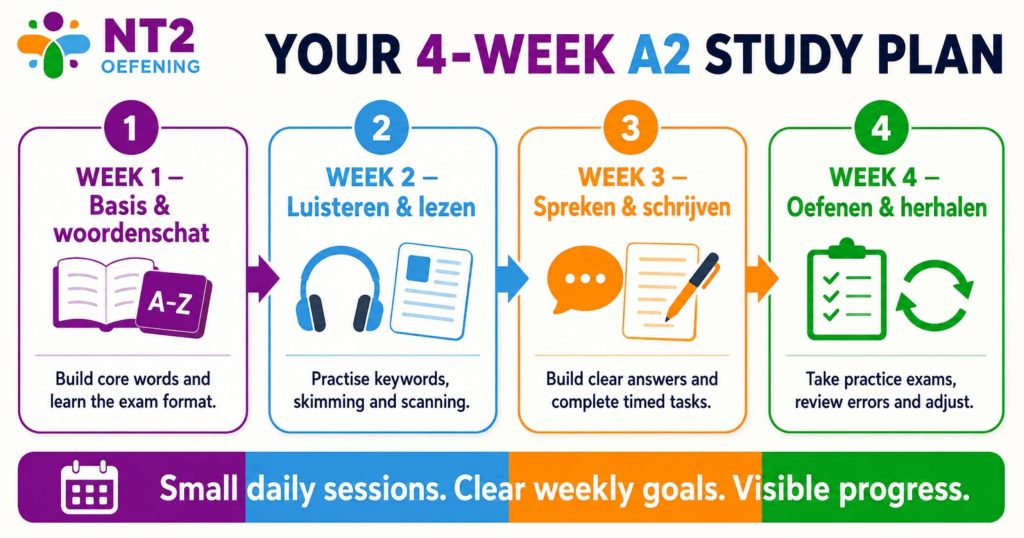
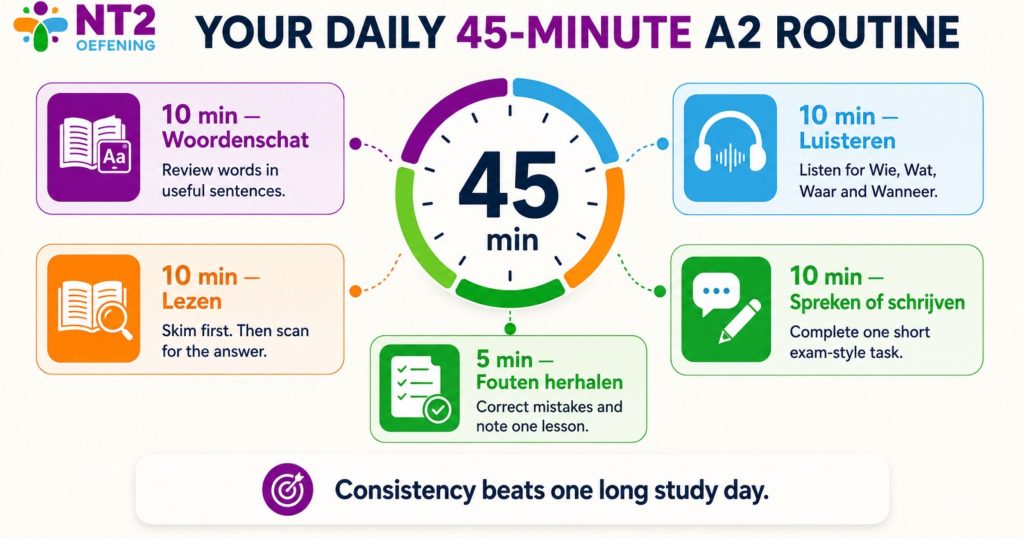
Week 1: build a baseline
Monday: complete one reading and listening task. Analyze every wrong answer.
Tuesday: practice personal details, family, and housing.
Wednesday: write a short message and complete a form.
Thursday: train numbers, times, and appointments in listening.
Friday: use skimming and scanning with three practical texts.
Saturday: complete a mixed mini-test.
Your goal is clarity. Choose three major problems, such as slow reading, weak vocabulary, or uncertain sentence order. Do not try to fix everything.

Week 2: build one method for every skill
Monday focuses on speaking. Use templates for opinions, appointments, problems, and requests. Record each answer.
Tuesday focuses on listening. Read the question first. Then, catch person, place, time, action, and corrections.
Wednesday focuses on reading. Use question, skim, scan, and close checking.
Thursday focuses on clear writing.
Friday combines grammar and vocabulary.
Saturday includes a half simulation. Your goal is a stable routine for every task.
Week 3: connect skills and topics
Choose one daily topic, such as health. Hear a dialogue, read a message, speak an answer, and write a short appointment note.
Use work on Tuesday, transport on Wednesday, shopping on Thursday, and authorities on Friday.
Train your weakest skill twice on Friday. However, select one precise problem. For example, practice only times during listening.
On Saturday, simulate two complete exam parts. Compare accuracy and time with week one. Change your plan only when the data supports it.
Week 4: simulate and review calmly
Monday: simulate your weakest skill.
Tuesday: review errors and key sentence patterns. Learn very few new words.
Wednesday: simulate two other parts with real time limits.
Thursday: review your error notebook and write one solution for every error type.
Friday: complete a light mixed session. Prepare documents, travel, food, and sleep.
Saturday should remain calm and short.
Your goal is reliable performance, not last-minute volume. Therefore, protect sleep and stop heavy study before the exam.
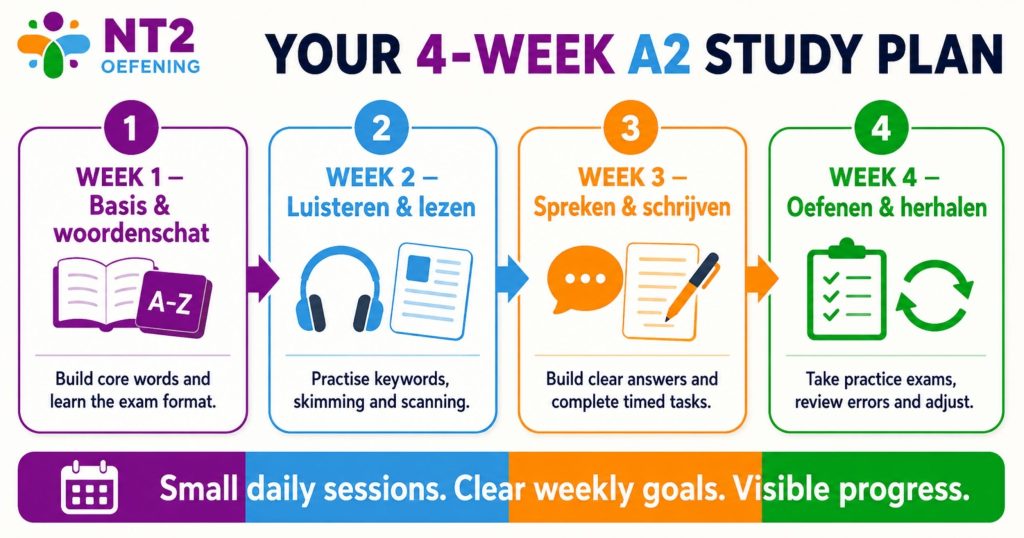
Daily 75-minute schedule
- Start with ten minutes of vocabulary recall. Then, spend twenty minutes on your main skill.
- Use the next twenty minutes for a second skill. After that, review mistakes for fifteen minutes.
- Finish with ten minutes of speaking or writing. This final production step checks active knowledge.
- Take a short break between blocks when needed. Moreover, reduce the session on busy days instead of skipping everything.
How to measure real progress
Track accuracy, time, and error types. A higher score with much more time may not show exam readiness.
Separate language errors from strategy errors. A missing word needs vocabulary work. A missed negation needs attention training.
Review the same weak point after three days. If it improves, continue. If it stays weak, simplify the exercise and rebuild the skill.
A useful Inburgering A2 study plan adapts to evidence. Therefore, your dashboard and error notebook should guide each new week.
A practice checklist
- Set one clear goal before each Inburgering A2 study plan session. A precise goal improves focus and makes progress measurable.
- Work under gentle time limits. First protect accuracy. Then, reduce the time in small steps.
- Write down every repeated error. Add the reason and one correct example. Review it after three days.
- Use Dutch during active practice. Translate only when a word blocks the main meaning.
- Mix focused drills with realistic tasks. Drills repair one weakness. Full tasks test whether the skill transfers.
- End each week with a short review. Compare accuracy, speed, confidence, and error patterns.
- Keep study sessions regular. Twenty focused minutes often helps more than irregular long sessions.
- Use reliable exam information. Check your personal requirements in Mijn Inburgering and use official DUO materials.
- During Inburgering A2 study plan practice, check the task before choosing your method. Then, complete the task without stopping. Finally, review both the result and the process.
- Regular Inburgering A2 study plan training should connect exam technique with real daily communication. This balance builds useful Dutch and steadier exam performance.
- Keep your materials simple and consistent. Use one error notebook, one progress record, and trusted practice sources. Therefore, you can see patterns clearly. Moreover, you avoid wasting time between different systems.
Conclusion
A strong Inburgering A2 study plan approach uses clear steps, regular practice, and honest error review. Therefore, focus on useful daily Dutch and repeatable exam techniques. Use official DUO material for orientation. In addition, use NT2 Oefening for targeted practice, direct feedback, and progress tracking. Start with one short session today, then build consistency throughout the week.
FAQ
Can I prepare for Inburgering A2 in four weeks?
Yes, if your Dutch already approaches A2. Four weeks can improve technique and close focused gaps. A complete beginner usually needs more time.
How many hours should I study daily?
Aim for 60 to 90 focused minutes on six days. Shorter daily practice usually works better than one very long weekly session.
Which Inburgering A2 skill should I study first?
Start with a diagnostic task. Then, prioritize the weakest skill and the error types that cost the most points.
Should I take full practice exams every day?
No. Daily full exams create fatigue and limited learning. Use skill drills during the week and one or two simulations.
What should I do on the day before the exam?
Review only key patterns and practical details. Avoid heavy new learning. Prepare documents, travel, meals, and sleep.
Disclaimer:
This blog is for informational and awareness purposes only. The content can be verified from other sources. The author accepts no legal responsibility for any decisions made based on this information.