


Introduction
Many candidates read every text word by word. Therefore, they waste time and energy. Inburgering A2 reading needs targeted information search.
DUO currently gives the A2 reading exam on a computer. You read practical texts and answer questions. The exam lasts about 65 minutes. So, good technique protects your time.
Skimming shows the topic and purpose. Scanning finds one specific detail. This guide combines both techniques into a fast, reliable routine.
Read the previous guide: Inburgering A2 Listening: How to Catch Keywords Fast
What do "skim" and "scan" mean?
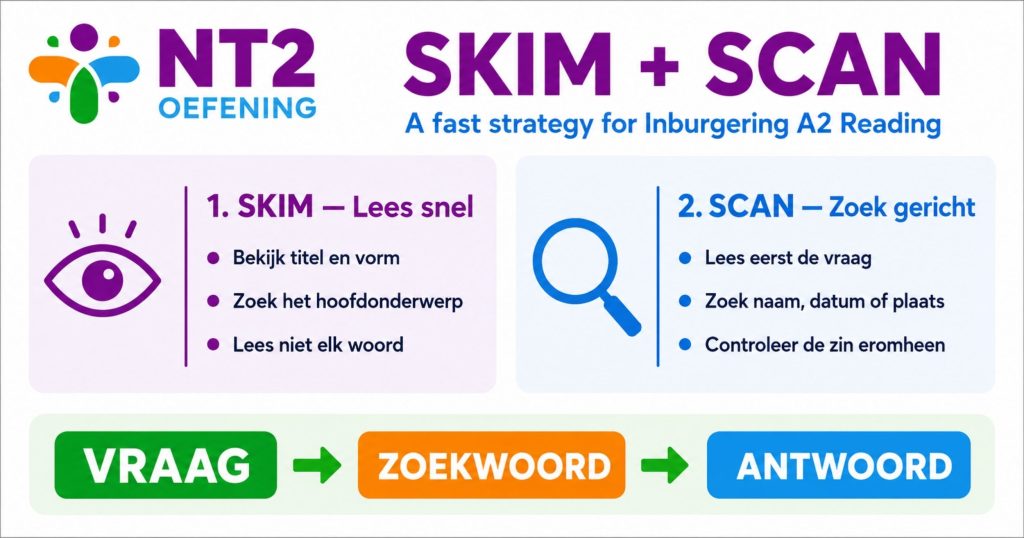
Skimming means reading for a quick overview. Look at the title, first sentence, and visible keywords. Then, decide whether the text informs, warns, requests, or invites.
Scanning means searching for one detail. Your eyes move across less important words. They stop at a name, date, price, place, or matching idea.
Both techniques need a clear question. Therefore, read the task first. Mark the question word and one central concept.
The text may use a synonym. The question may say “cost,” while the text shows “prijs” or a euro sign. Build common synonym pairs during practice.
The five-step reading method
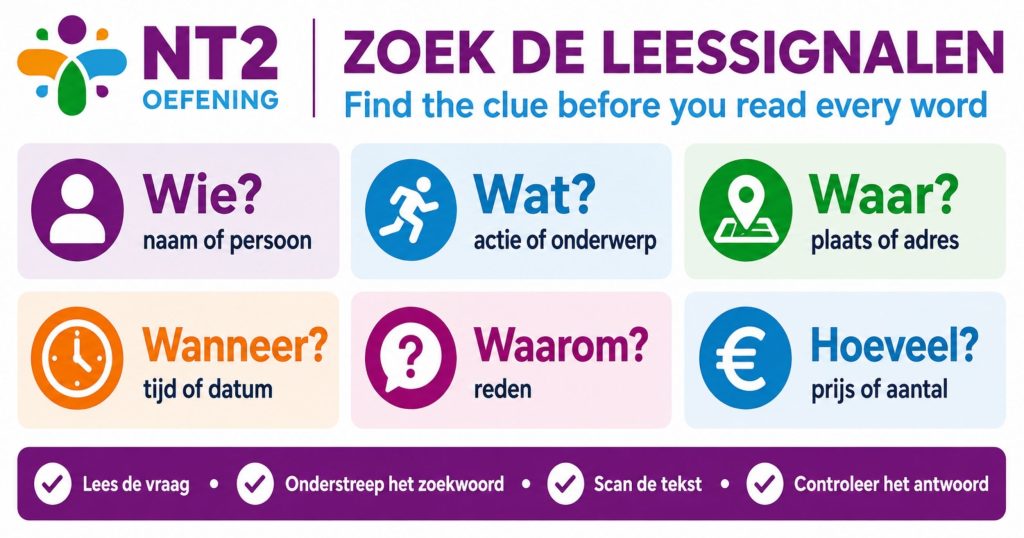
- 1. Read the question. Identify the person, action, and requested detail.
- 2. Skim the text for ten seconds. Decide its topic and text type.
- 3. Scan for signals, such as names, capitals, numbers, times, or repeated words.
- 4. Read two sentences around the signal. Check conditions and negative words.
- 5. Compare every option. Choose the answer that matches all details, not only one word.
Text signals that reveal answers
Headings usually show the topic. The first sentence often explains the situation. The final sentence may contain a request or next action.
Numbers show prices, dates, times, and quantities. Symbols also help. For example, a euro sign points to cost.
Connectors change logic. Maar shows contrast. Omdat gives a reason. Daarom gives a result. Als gives a condition. Niet makes a statement negative.
Text types create expectations. An invitation includes a date and place. A complaint includes a problem and request. An advert includes a product, price, and contact.
Time management without panic
- Start with clear questions and collect easy points. Mark difficult items and return later.
- Set a time limit during practice. Reduce it slowly each week. However, always measure accuracy with speed.
- Do not spend three minutes on one unknown word. Ask whether you need it. Often, the surrounding sentence gives enough meaning.
- Practice on a screen because the official exam uses a computer. NT2 Oefening offers exam-style tasks and a dashboard for accuracy and progress.
Typical reading mistakes
Some learners read the full text before the question. Reverse this order. The question gives your reading goal.
Others search only for an identical word. Exams often use another expression. Therefore, build synonym groups.
A wrong option may contain one true detail. Check the complete statement. The place, time, and action must agree.
Finally, mark niet, geen, and behalve. These small words can reverse the answer.

A practice checklist
- Set one clear goal before each Inburgering A2 reading session. A precise goal improves focus and makes progress measurable.
- Work under gentle time limits. First protect accuracy. Then, reduce the time in small steps.
- Write down every repeated error. Add the reason and one correct example. Review it after three days.
- Use Dutch during active practice. Translate only when a word blocks the main meaning.
- Mix focused drills with realistic tasks. Drills repair one weakness. Full tasks test whether the skill transfers.
- End each week with a short review. Compare accuracy, speed, confidence, and error patterns.
- Keep study sessions regular. Twenty focused minutes often helps more than irregular long sessions.
- Use reliable exam information. Check your personal requirements in Mijn Inburgering and use official DUO materials.
- During Inburgering A2 reading practice, check the task before choosing your method. Then, complete the task without stopping. Finally, review both the result and the process.
- Regular Inburgering A2 reading training should connect exam technique with real daily communication. This balance builds useful Dutch and steadier exam performance.
- Keep your materials simple and consistent. Use one error notebook, one progress record, and trusted practice sources. Therefore, you can see patterns clearly. Moreover, you avoid wasting time between different systems.
Conclusion
A strong Inburgering A2 reading approach uses clear steps, regular practice, and honest error review. Therefore, focus on useful daily Dutch and repeatable exam techniques. Use official DUO material for orientation. In addition, use NT2 Oefening for targeted practice, direct feedback, and progress tracking. Start with one short session today, then build consistency throughout the week.
FAQ
How can I read faster for Inburgering A2?
Read the question first. Skim for the topic, scan for a signal, and read only the relevant lines carefully.
What is skimming in Dutch reading?
Skimming is a fast overview. You inspect headings, opening sentences, and keywords to identify topic and purpose.
What is scanning in an A2 reading exam?
Scanning means searching for a specific detail, such as a time, price, person, or location.
Should I translate every unknown Dutch word?
No. First decide whether the word controls the answer. Use context, familiar word parts, and nearby sentences.
How should I manage 65 minutes?
Secure easy answers first, mark difficult questions, and reserve final minutes for review. Practice this routine under timed conditions.
Disclaimer:
This blog is for informational and awareness purposes only. The content can be verified from other sources. The author accepts no legal responsibility for any decisions made based on this information.