


Introduction
Many learners know Dutch words but still freeze during a speaking task. They often lack a clear answer structure. Inburgering A2 speaking rewards clear and relevant communication. Therefore, a simple template can reduce stress and save time.
DUO currently gives the A2 speaking exam on a computer. You watch short videos and answer spoken questions. The exam lasts about 35 minutes. So, you need calm, clear, and direct answers.
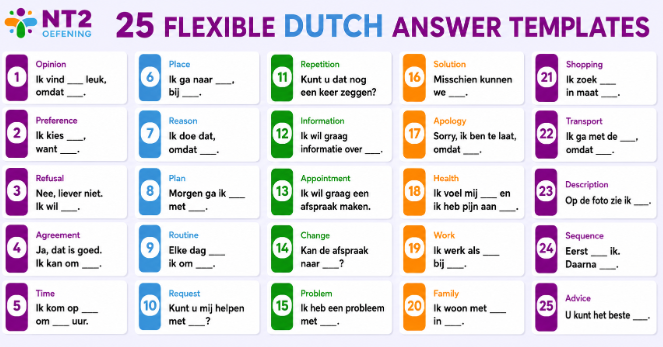
This guide gives you 25 flexible answer templates. Do not learn them as fixed scripts. Instead, change the person, place, time, action, or reason. As a result, one pattern can support many exam situations.
Read the previous guide: Inburgering A2 Exam Format in 10 Minutes
What does the Inburgering A2 speaking exam test?
The exam checks understanding and speaking together. First, you identify the situation. Next, you notice the question word. Finally, you record a suitable answer.
At the A2 level, clear meaning matters most. Use familiar words and short sentence patterns. Small mistakes may occur. However, your main message must remain easy to understand.
Question words guide your answer. Waar asks for a place. Wanneer asks for a time. Waarom asks for a reason. Hoe asks about a method. Wat vindt u asks for an opinion.
Never answer with only “ja” or “nee.” Add one useful detail. For example, say: Ja, ik kom morgen om tien uur. This answer gives both a decision and a time.
25 flexible Dutch answer templates
How to make every answer complete
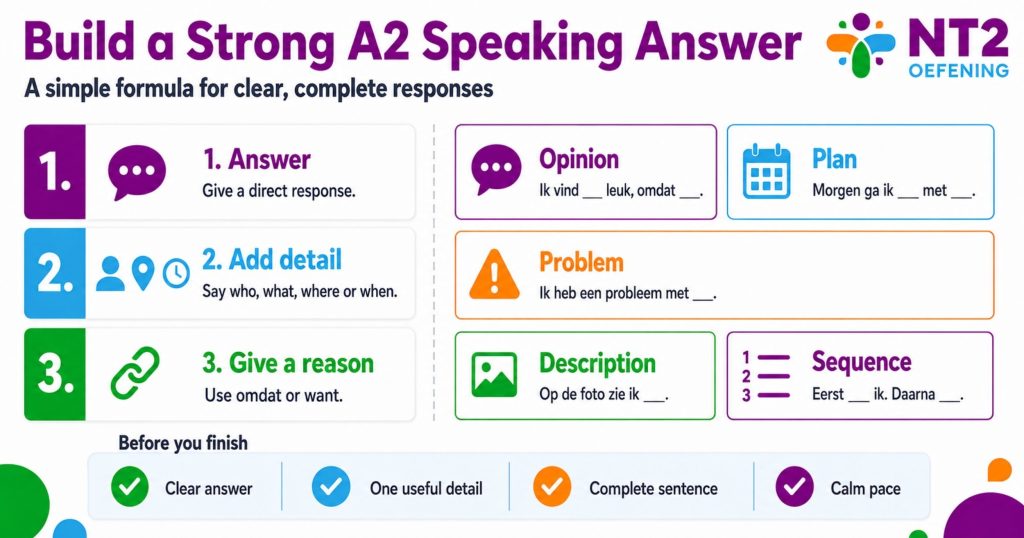
Use a simple three-part model. Start with the direct answer. Then, add one detail. Finally, add a reason when the question needs one.
For example, answer a preference question with: Ik kies de fiets. Het is dichtbij. Daarom ben ik snel thuis. The answer stays simple, yet it sounds complete.
Do not add unrelated facts. They increase your error risk. Moreover, they can hide your main answer. One or two correct sentences usually work better than four uncertain sentences.
Use clear pronunciation and a steady speed. Speak toward the microphone. Also, finish your final word before you stop the recording.

A practical daily speaking routine
Choose five templates each day. Create three new answers for every template. Therefore, you produce fifteen short answers daily.
Record every answer on your phone or computer. Then, listen once for meaning. Listen again for verb position, endings, and missing words.
Repeat weak answers immediately. However, do not repeat a mistake ten times. Read the correct version first. Then, record it again without looking.
Practice with everyday topics, such as work, health, travel, family, and shopping. NT2 Oefening gives exam-style practice and direct feedback. Its dashboard also shows your progress.
Common mistakes and expert fixes
Some learners translate a long sentence from their first language. This creates pauses and word-order errors. Instead, build the answer with known Dutch blocks.
Other learners memorize one perfect answer. However, the exam question may change. Learn flexible patterns and replace key information.
Many candidates speak too softly or too quickly. Therefore, test your microphone before practice. Use a natural speed and clear sentence endings.
Finally, always answer the exact question. A grammatically correct answer can still miss the task. Check the question word before you speak.
Expert practice checklist
- Set one clear goal before each Inburgering A2 speaking session. A precise goal improves focus and makes progress measurable.
- Work under gentle time limits. First protect accuracy. Then, reduce the time in small steps.
- Write down every repeated error. Add the reason and one correct example. Review it after three days.
- Use Dutch during active practice. Translate only when a word blocks the main meaning.
- Mix focused drills with realistic tasks. Drills repair one weakness. Full tasks test whether the skill transfers.
- End each week with a short review. Compare accuracy, speed, confidence, and error patterns.
- Keep study sessions regular. Twenty focused minutes often helps more than irregular long sessions.
- Use reliable exam information. Check your personal requirements in Mijn Inburgering and use official DUO materials.
- During Inburgering A2 speaking practice, check the task before choosing your method. Then, complete the task without stopping. Finally, review both the result and the process.
- Regular Inburgering A2 speaking training should connect exam technique with real daily communication. This balance builds useful Dutch and steadier exam performance.
- Keep your materials simple and consistent. Use one error notebook, one progress record, and trusted practice sources. Therefore, you can see patterns clearly. Moreover, you avoid wasting time between different systems.

Conclusion
A strong Inburgering A2 speaking approach uses clear steps, regular practice, and honest error review. Therefore, focus on useful daily Dutch and repeatable exam techniques. Use official DUO material for orientation. In addition, use NT2 Oefening for targeted practice, direct feedback, and progress tracking. Start with one short session today, then build consistency throughout the week.
FAQ
How can I pass the Inburgering A2 speaking exam?
Answer every question directly, add one useful detail, and speak clearly. Practice with timed computer tasks. Also, review your recordings and correct repeated errors.
How long should an A2-speaking answer be?
Most answers need one or two clear sentences. A longer answer does not automatically earn more credit. Relevance, understandable speech, and useful detail matter more.
Can I use memorized templates in the Dutch A2 speaking exam?
Yes, you can use sentence patterns. However, adapt them to the exact question. A fixed script can become irrelevant, while a flexible template supports natural answers.
What happens if I make grammar mistakes?
A small mistake does not always destroy communication. Keep the verb, person, time, and action clear. Then, the listener can still understand your main message.
How often should I practice Dutch speaking?
Practice for 15 to 20 minutes daily. Short daily sessions build faster recall. In addition, complete two longer exam simulations each week.
Disclaimer:
This blog is for informational and awareness purposes only. The content can be verified from other sources. The author accepts no legal responsibility for any decisions made based on this information.