


Introduction
Many learners try to understand every spoken word. Therefore, they lose the main message. Inburgering A2 listening requires targeted understanding, not perfect translation.
DUO currently delivers this exam on a computer. You watch videos, hear spoken Dutch, and answer questions. The exam lasts about 45 minutes. So, a repeatable listening strategy matters.
This guide shows how to predict, catch, and confirm keywords. In addition, it explains distractors, number problems, and daily training.
Read the previous guide: Inburgering A2 Speaking: 25 Ready-to-Use Answer Templates
What are listening keywords?
Keywords carry the central information. They often include nouns, verbs, names, numbers, places, and times. Words like morgen, huisarts, trein, and betalen quickly show the situation.
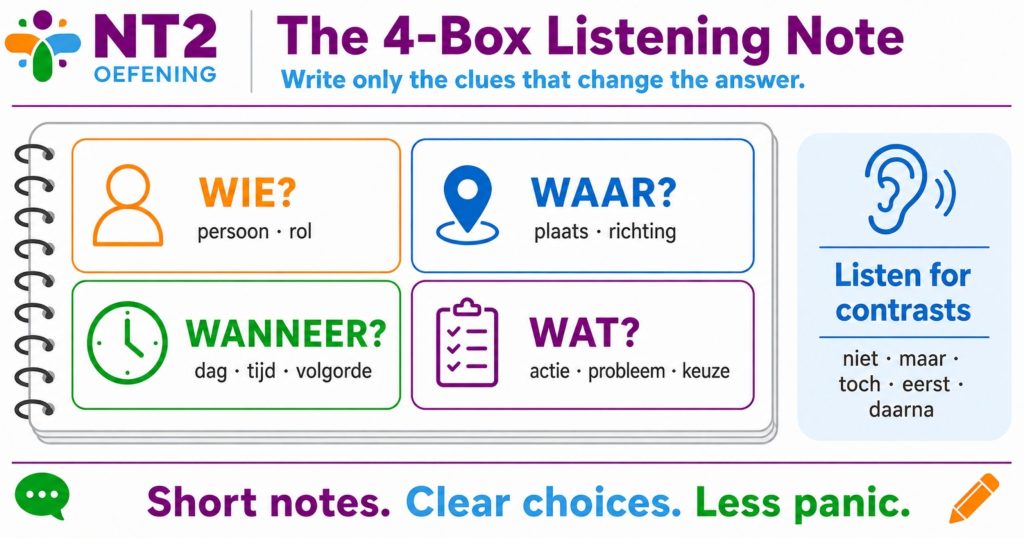
Question words control your attention. Wie points to a person. Waar points to a place. Wanneer points to a time. Hoeveel points to a number. Waarom points to a reason.
Signal words show relationships. Maar introduces contrast. Omdat introduces a reason. Dus introduces a result. Eerst and daarna show order. Niet changes the meaning completely.
However, one keyword may mislead you. A speaker may say zaterdag and then correct it. Therefore, wait for the complete idea before choosing.
The fast four-step keyword method
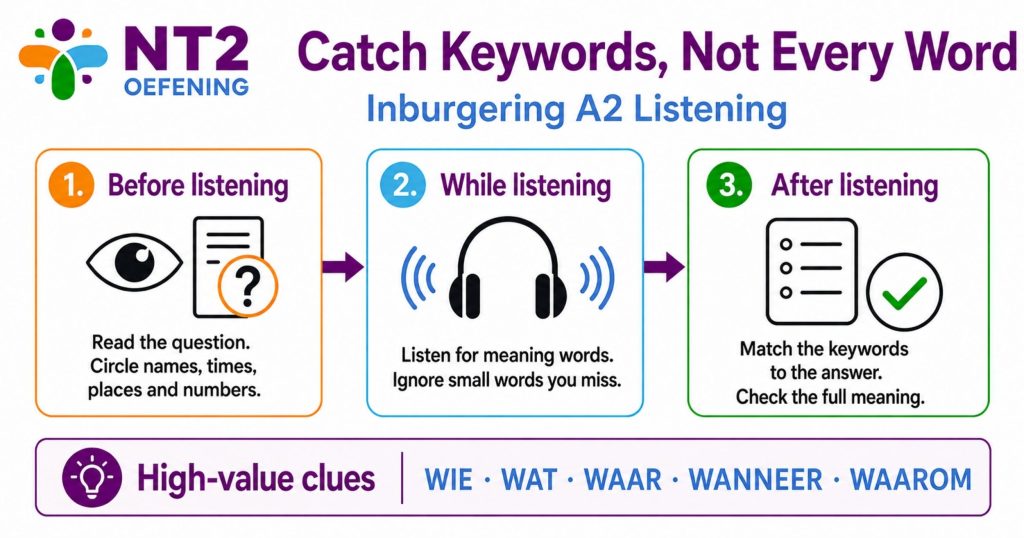
- First, read the question and all options. Mark their differences. For example, only the time or location may change.
- Second, predict the information type. When asked for a day or time. Why asks for a reason. This prediction prepares your attention.
- Third, listen for linked keywords. Do not collect isolated words. Connect the person, action, place, and time.
- Fourth, confirm the main message. Check negations, contrasts, and corrections. Then, select the option that matches the full meaning.
High-value word groups for A2
Learn time words together: vandaag, morgen, gisteren, straks, vroeg, and laat. Also, practice weekdays, dates, and clock times.
Learn common places: thuis, kantoor, station, gemeente, ziekenhuis, school, and winkel. Connect every place with typical actions.
Train Dutch numbers, prices, and dates. Dertien and dertig can sound similar. Therefore, compare them in short recordings.
Collect action verbs, such as komen, gaan, brengen, halen, bellen, betalen, and veranderen. These verbs often carry the task’s main action.

How to train your ear every day
Plan fifteen focused minutes. First, hear a short dialogue without subtitles. Write the person, place, time, and action.
Next, hear it again. Add missing information. Then, read the transcript when available. Mark keywords and signal words.
Use shadowing for difficult sentences. Repeat directly after the speaker. As a result, you connect sound, rhythm, and written forms.
Twice weekly, complete exam-style tasks. NT2 Oefening provides practice formats, direct feedback, and progress data. Review why each wrong answer failed.
Common listening traps
A familiar word can act as a distractor. The audio may mention one option before giving the real answer. Therefore, follow the full sentence.
Some learners read options during the audio. This splits attention. Read them first and identify their differences.
An unknown word can cause panic. Keep listening because the next sentence may explain it. Often, you do not need that word.
Numbers require separate practice. Ask someone or an app to read random times and prices. Write each answer immediately, then check it.
Expert practice checklist
- Set one clear goal before each Inburgering A2 listening session. A precise goal improves focus and makes progress measurable.
- Work under gentle time limits. First, protect accuracy. Then, reduce the time in small steps.
- Write down every repeated error. Add the reason and one correct example. Review it after three days.
- Use Dutch during active practice. Translate only when a word blocks the main meaning.
- Mix focused drills with realistic tasks. Drills repair one weakness. Full tasks test whether the skill transfers.
- End each week with a short review. Compare accuracy, speed, confidence, and error patterns.
- Keep study sessions regular. Twenty focused minutes often helps more than irregular long sessions.
- Use reliable exam information. Check your personal requirements in Mijn Inburgering and use official DUO materials.
- During Inburgering A2 listening practice, check the task before choosing your method. Then, complete the task without stopping. Finally, review both the result and the process.
- Regular Inburgering A2 listening training should connect exam technique with real daily communication. This balance builds useful Dutch and steadier exam performance.
- Keep your materials simple and consistent. Use one error notebook, one progress record, and trusted practice sources. Therefore, you can see patterns clearly. Moreover, you avoid wasting time between different systems.
Conclusion
A strong Inburgering A2 listening approach uses clear steps, regular practice, and honest error review. Therefore, focus on useful daily Dutch and repeatable exam techniques. Use official DUO material for orientation. In addition, use NT2 Oefening for targeted practice, direct feedback, and progress tracking. Start with one short session today, then build consistency throughout the week.
FAQ
How can I improve Inburgering A2 listening quickly?
Practice short exam-style audio every day. Predict the answer type, catch linked keywords, and review the exact reason for every mistake.
What keywords matter in the Dutch A2 listening exam?
Focus on people, actions, places, times, prices, negations, and contrast words. These details often separate the correct option from distractors.
Do I need to understand every Dutch word?
No. You need the main message and the requested detail. Keep listening after an unknown word and use context.
Why do I understand Dutch text but not spoken Dutch?
Spoken words connect and change rhythm. Use transcripts, shadowing, and repeated short clips to connect spelling with real sound.
How should I practice Dutch numbers?
Mix prices, dates, phone numbers, and times. Write them during listening, then compare. Practice similar pairs, such as dertien and dertig.
Disclaimer:
This blog is for informational and awareness purposes only. The content can be verified from other sources. The author accepts no legal responsibility for any decisions made based on this information.