

Introduction
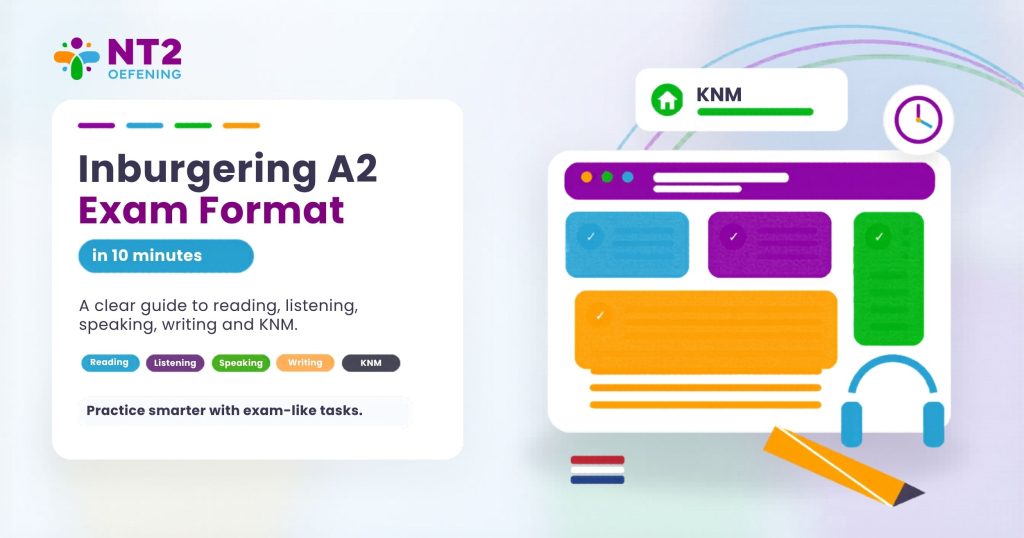
The Inburgering A2 exam format can feel big at first. However, it becomes simple with a clear map. You only need to know each part. Then, you can prepare step by step. This guide explains the exam in plain English. So, you can understand the format in 10 minutes.
The Dutch integration exam checks your Dutch skills. In addition, it checks your knowledge of Dutch society. However, your exact exams can depend on your situation. Therefore, always check Mijn Inburgering first. DUO also says your exams depend on the law that applies to you.
What is the inburgering A2 exam?
The Inburgering exam helps show your Dutch level. At A2, you use Dutch in daily life. For example, you read short texts. You also listen to simple messages. In addition, you speak about common topics. You write short and useful texts.
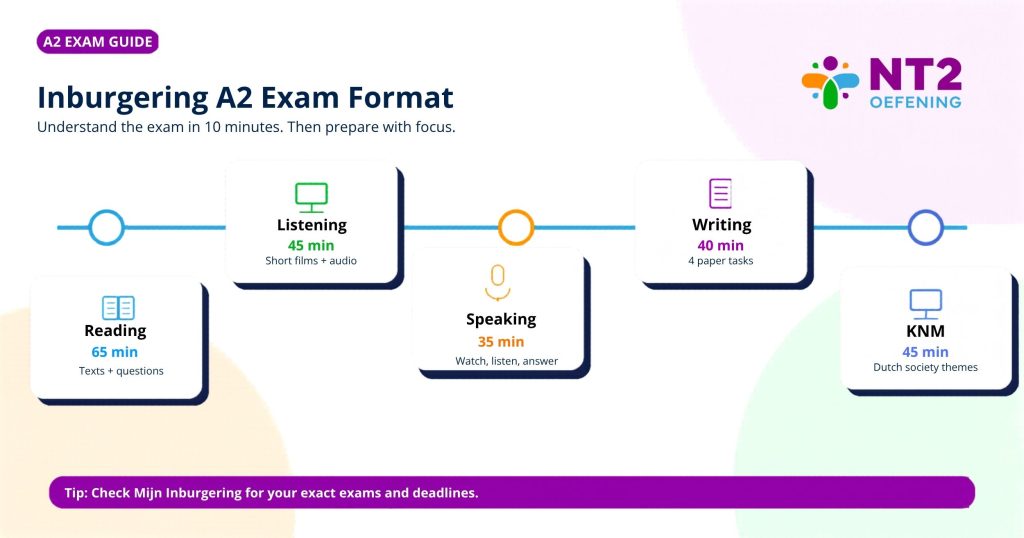
The Inburgering A2 exam format usually includes these parts:
- Reading
- Listening
- Speaking
- Writing
- Knowledge of Dutch Society, also called KNM
Some people may also need other parts. For example, ONA or PVT can apply. However, this depends on your integration law. So, check your personal exam list.
Quick overview of the A2 parts
The A2 language exams use simple daily situations. Therefore, you do not need academic Dutch. Instead, you need practical Dutch.
You take reading on a computer. You read texts and answer questions. The exam lasts 65 minutes. You take listening on a computer too. You watch short films and hear texts. The exam lasts 45 minutes.
You take speaking on a computer. You watch short films. Then, you answer questions in Dutch. This exam lasts 35 minutes. You take writing with a pen and paper. DUO gives you 4 assignments. The exam lasts 40 minutes.
KNM is also on a computer. It checks your knowledge of Dutch society. For example, topics include living, work, and income. The KNM exam lasts 45 minutes.
Reading exam at A2
The reading part checks practical understanding. You read short texts. Then, you answer questions. These texts can look like daily Dutch.
For example, you may see:
- A short email
- A public sign
- A simple letter
- A website text
- A notice from a school or office
Therefore, you should practice short texts often. Also, do not translate every word. Instead, find the main message first. Then, look for key details.
A good reading habit helps a lot. First, read the question. Then, read the text. After that, find the answer. This saves time. Moreover, it reduces stress.
Listening exam at A2
The listening exam checks daily understanding. You hear short Dutch texts. You may also watch short films. Then, you answer questions.
The topics are usually common. For example, you may hear information about appointments. You may also hear messages about travel, work, school, or shopping.
So, practice listening with real situations. Listen for names, times, places, and actions. In addition, train with short videos. This helps your ears get used to Dutch.
Do not worry about every word. Instead, listen for the main idea. Then, listen again for details during practice.
Speaking exam at A2
The speaking exam checks how you answer in Dutch. You use a computer. You watch short films. Then, you answer with your voice.
You do not need long answers. However, your answer must fit the task. So, speak clearly. Use short sentences. Also, answer the question directly.
For example, you may need to:
- Ask for information
- Give your opinion
- Explain a simple situation
- Respond to a daily problem
- Describe something in a picture
Therefore, record yourself often. Then, listen again. This helps you hear your mistakes. In addition, it builds exam confidence.
Writing exam at A2
The writing exam uses pen and paper. DUO gives you 4 assignments. These tasks are practical. For example, you may fill in a form. You may also write a short letter.
At A2, structure matters. So, write simple sentences. Also, answer every task point. Do not write too much. However, do not leave important points out.
A good writing answer has:
- A clear start
- The needed information
- Simple grammar
- Correct spelling
- A polite ending, when needed
Therefore, practice forms, emails, and short notes. In addition, check your word order. Dutch word order can cause many mistakes.
KNM: Knowledge of Dutch Society
KNM means Knowledge of Dutch Society. This exam checks daily life in the Netherlands. Therefore, you need more than language.
You may get questions about work. You may also get questions about housing, health, school, and rules. In addition, you need to understand common Dutch habits.
For example, you may learn:
- How to make an appointment
- How schools work
- How healthcare works
- How to look for work
- How Dutch public services work
So, study KNM with real examples. This makes the content easier. Also, connect each topic with your own life.
How to prepare in a smart way
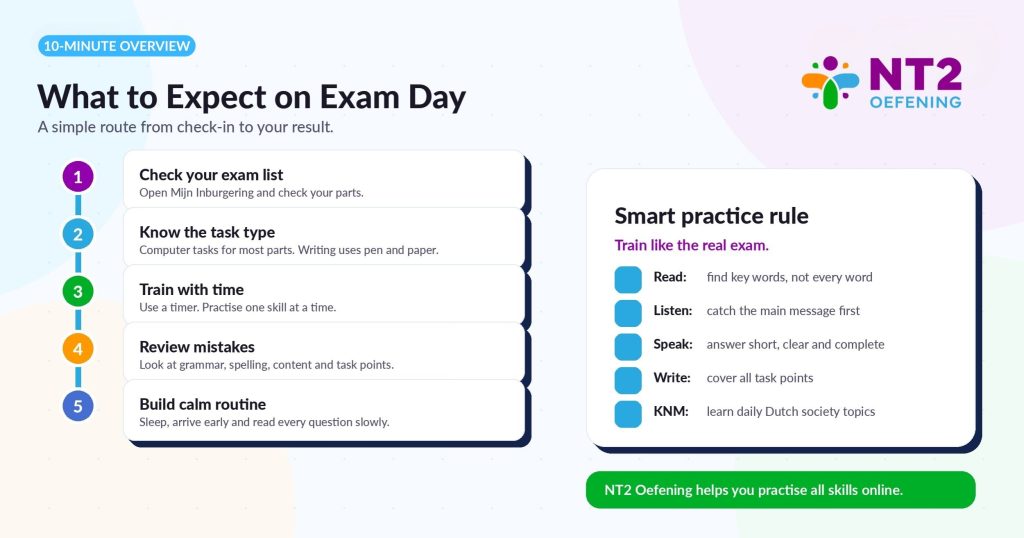
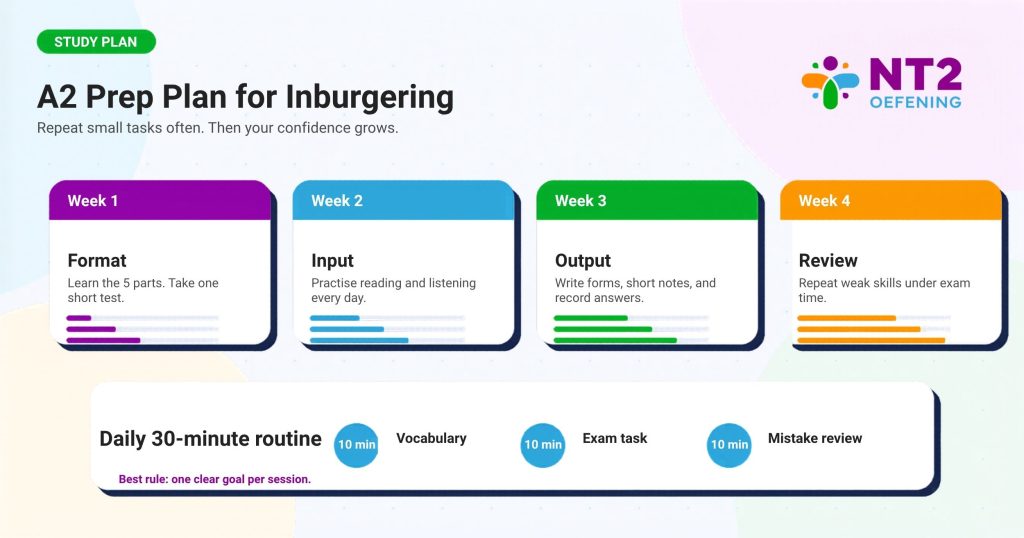
The Inburgering A2 exam format becomes easier with routine. Therefore, make a simple plan. You do not need long study days. Instead, study often.
A good daily plan can look like this:
- 10 minutes vocabulary
- 10 minutes exam practice
- 10 minutes mistake review
This is simple, but it works. In addition, repeat weak skills often. For example, if speaking feels hard, record one answer daily. If writing feels hard, write one short email daily.
Also, use timed practice. Because the real exam has time limits, timing matters. So, practice with a timer. Then, your exam day feels more normal.
Common mistakes to avoid
Many learners study words only. However, the exam checks tasks. So, you must practice the real format.
Another mistake is ignoring writing and speaking. Reading and listening feel easier to practice. However, writing and speaking need active training.
Also, some learners use long sentences. This can create more mistakes. Therefore, use short A2 sentences. For example, write one idea per sentence.
In addition, many learners skip review. But review is very important. You learn faster when you study your mistakes. So, keep a mistake list. Then, repeat the same grammar point.
How NT2 Oefening helps
NT2 Oefening helps you practice for Dutch integration exams. It offers practice for reading, listening, speaking, and writing. In addition, it gives instant feedback for speaking and writing tasks.
This helps you learn from mistakes quickly. You can also monitor your progress in your dashboard. Therefore, you know your level better. NT2 Oefening also uses similar question types and exam-like content. So, you can train with more focus.
Build better Dutch sentences
Do you want to improve your Dutch after A2? Then read this helpful blog next:
From A2 to B1: How to Build Better Sentences in Dutch This article helps you move from short A2 sentences to better B1 sentences. In addition, it explains sentence building simply.
Test German: Practice for German exams
Test German is useful for German exams. It focuses on Goethe, telc, and DTZ exam formats. In addition, it offers real exam-style practice. It gives AI feedback in your own language and supports 18 feedback languages.
The platform includes full exam simulations. It also gives clear scoring and quick corrections. In addition, it offers different roadmaps like Visa & Family and Integration & Citizenship. These paths help learners choose the right goal.
Conclusion
The Inburgering A2 exam format is clear when you know the parts. You practice reading, listening, speaking, writing, and KNM. Each part checks the daily Dutch. Therefore, smart practice matters more than hard study.
Start with the format. Then, practice one skill at a time. In addition, review your mistakes often. This helps you improve faster. Finally, use exam-like tools, because they show real progress. With the right plan, the Inburgering A2 exam format becomes much less stressful.
Disclaimer:
This blog is for informational and awareness purposes only. The content can be verified from other sources. The author accepts no legal responsibility for any decisions made based on this information.