


Introduction
Better sentences in Dutch help you move from A2 to B1 with more confidence. At the A2 level, you can share simple ideas. However, B1 asks for more detail. You must explain reasons, connect ideas, and describe situations clearly. Therefore, sentence building becomes very important.
Many learners know many Dutch words. However, they still write short sentences. They often repeat the same structure. For example, they write, “Ik ga naar school. Ik leer Nederlands. Ik heb examen.” These sentences work. However, they sound basic.
At the B1 level, you need more control. You need better word order. You also need connectors, reasons, examples, and time words. Because of this, you should train sentence building every week.
In this blog, you will learn simple ways to build better sentences in Dutch. You will see clear examples. You will also learn how to improve your writing and speaking for NT2 exams.
Why sentence quality matters at B1
B1 Dutch does not mean perfect Dutch. However, it means clear Dutch. You can make small mistakes. Still, people must understand your message.
At the A2 level, you often talk about daily needs. For example, you can make an appointment. You can ask for help. You can describe your family. However, B1 needs more independence.
At B1, you explain your opinion. You also describe problems. In addition, you give reasons and solutions. Therefore, your sentences need more structure.
Compare these examples:
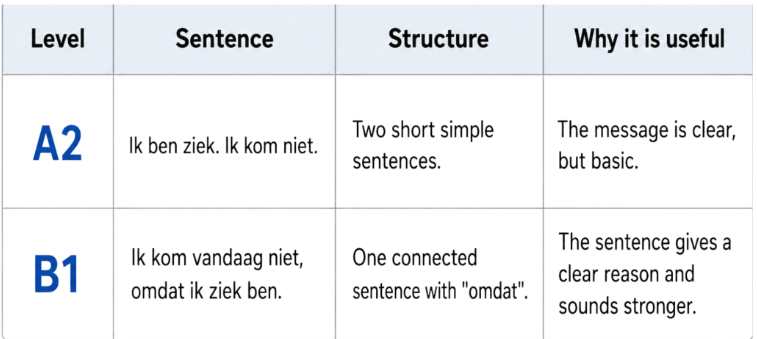
Better sentences also help in writing exams. They show that you can organize thoughts. Moreover, they help the reader follow your idea.
1. Start with one clear idea
A good Dutch sentence starts with one clear idea. Many learners try to say too much. As a result, the sentence becomes confusing. So, first choose your main idea. Then add one extra detail. After that, add a reason or example.
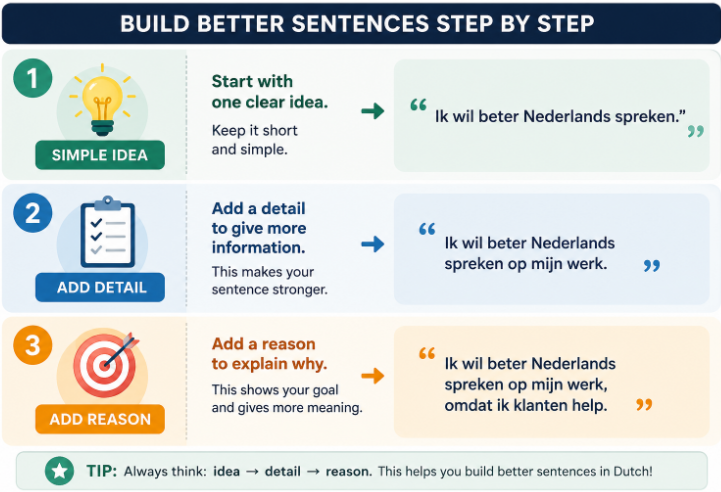
Example:
“Ik oefen elke dag Nederlands, omdat ik mijn examen wil halen.”
This sentence stays clear. It also gives a reason. Therefore, it sounds more like B1.
2. Use connectors to link ideas
Connectors help you build better sentences in Dutch. They show the relation between ideas. In addition, they make your writing smoother. At A2 level, learners often use “en” too much. “En” works, but it stays basic. Therefore, you should learn more connectors.
Useful Dutch connectors:
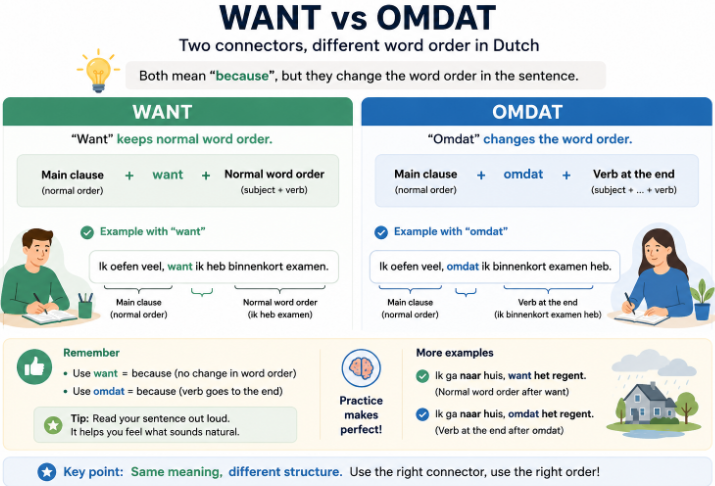
- want = because
- omdat = because
- maar = but
- dus = so
- daarom = therefore
- ook = also
- daarnaast = in addition
- bijvoorbeeld = for example
- eerst = first
- daarna = after that
- soms = sometimes
Examples:
- “Ik leer Nederlands, want ik woon in Nederland.”
- “Ik maak fouten, maar ik blijf oefenen.”
- “Ik wil mijn examen halen, dus ik oefen elke week.”
These connectors help your sentence grow. However, you must use them correctly. “Want” keeps normal word order. “Omdat” changes the word order.
3. Learn Dutch word order step by step
Dutch word order can feel difficult. However, you can learn it in small steps. You do not need every rule at once.
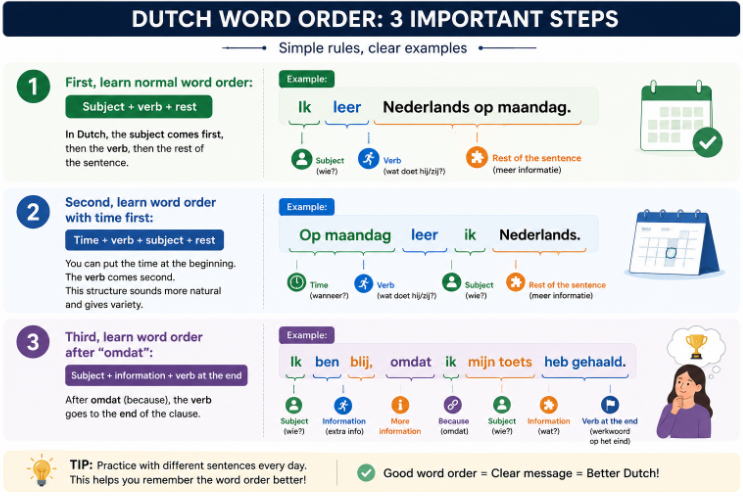
Word order also helps your speaking. You can answer longer questions with more control. Therefore, do not only study vocabulary. Study sentence patterns too.
4. Make short sentences stronger
You do not always need long sentences. Short sentences can work well. However, you should make them more meaningful.
Basic sentence:
“Ik werk.”
Better sentence:
“Ik werk drie dagen per week.”
Stronger sentence:
“Ik werk drie dagen per week in een supermarkt.”
B1 sentence:
“Ik werk drie dagen per week in een supermarkt, omdat ik ervaring wil opdoen.”
This step-by-step method helps many learners. You keep control, but you add detail. Try this with five common verbs:
- wonen
- werken
- leren
- oefenen
- zoeken
Example:
A2: “Ik zoek werk.”
B1: “Ik zoek werk in de zorg, omdat ik graag mensen help.”
This sentence gives a topic and a reason. So, it sounds clearer and more personal.
5. Add reasons and examples
B1 learners need to explain ideas. Therefore, reasons and examples matter.
Use these words:
- omdat = because
- want = because
- daarom = therefore
- bijvoorbeeld = for example
Example:
- “Ik wil beter schrijven, omdat ik vaak e-mails moet sturen.”
- “Ik oefen met voorbeeldzinnen, want dat helpt mijn grammatica.”
- “Ik maak soms fouten. Daarom lees ik mijn tekst opnieuw.”
- “Bijvoorbeeld, ik controleer de werkwoorden na het schrijven.”
These sentences show thinking. They also show that you can organize information. As a result, your Dutch becomes stronger.
For NT2 writing, this skill helps a lot. You can explain a problem. You can also give a solution. In addition, you can write a clear opinion.
6. Use time words for better structure
Time words also help you build better sentences in Dutch. They guide the reader through your story.
Useful time words:
- eerst = first
- daarna = after that
- later = later
- vandaag = today
- gisteren = yesterday
- morgen = tomorrow
- volgende week = next week
- sinds = since
- altijd = always
- meestal = usually
Example:
- “Eerst lees ik de opdracht goed.”
- “Daarna schrijf ik mijn antwoord.”
- “Later controleer ik de grammatica.”
These sentences create order. Therefore, your writing looks more planned. You can also use time words at the start. Then the verb comes second.
Example:
- “Morgen oefen ik met spreken.”
- “Volgende week maak ik een oefentoets.”
This structure gives variety. Moreover, it helps you avoid repeating “ik” first.
7. Avoid common A2 mistakes
Many learners repeat the same mistakes between A2 and B1. So, you should notice them early.
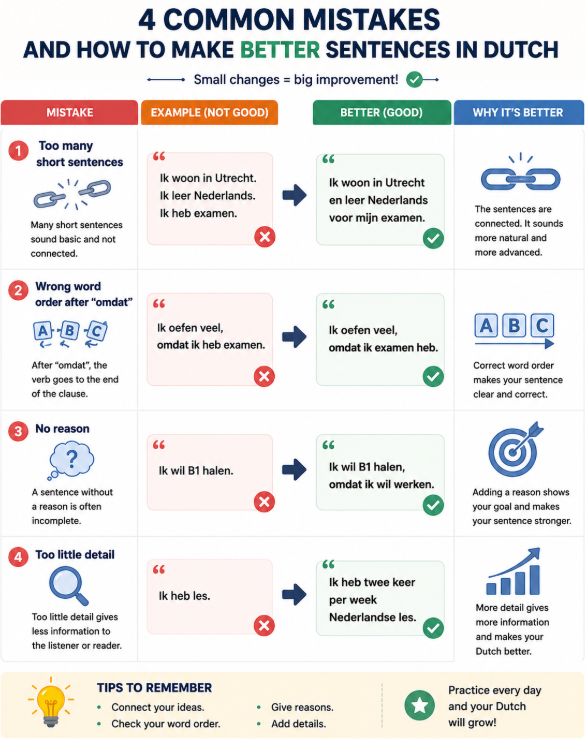
These small changes help a lot. Because of them, your Dutch becomes clearer.
8. Practice with real exam topics
You improve faster with real topics. Therefore, practice with themes from daily life. These themes often appear in NT2 exams.
Good topics include:
- work
- school
- health
- family
- housing
- appointments
- transport
- money
- study plans
- official letters
For example, write five sentences about work:
- “Ik zoek werk in een winkel.”
- “Ik wil graag met mensen werken.”
- “Ik heb ervaring met klanten.”
- “Ik oefen Nederlands, omdat werkgesprekken belangrijk zijn.”
- “Daarom leer ik elke week nieuwe woorden.”
This short text already sounds more B1. It includes a goal, reason, and detail.
For more exam support, read this NT2 Oefening blog: Extra time for the mandatory Dutch B1 integration exam (Inburgeringsexamen). It helps learners understand time rules for the B1 integration process.
9. Use feedback to improve faster
Practice helps. However, feedback helps even more. Many learners repeat mistakes because they do not see them. Therefore, instant feedback can save time.
NT2 Oefening helps learners practice Dutch exam skills. You can train writing, speaking, reading, and listening. In addition, you can see your progress. So, you know what needs more work.
When you write, check three things:
- First, check the verb.
- Second, check the word order.
- Third, check your reason or example.
Ask yourself:
- “Did I explain my idea?”
- “Did I use a connector?”
- “Did I give enough detail?”
- “Can the reader understand me?”
These questions help you improve sentence quality. Moreover, they train exam thinking.
Learners who also prepare for German exams can visit Test German. It supports Goethe, telc, and DTZ practice with AI feedback.
A simple weekly practice plan
A clear plan helps you build better sentences in Dutch. You do not need many hours. However, you need regular practice.
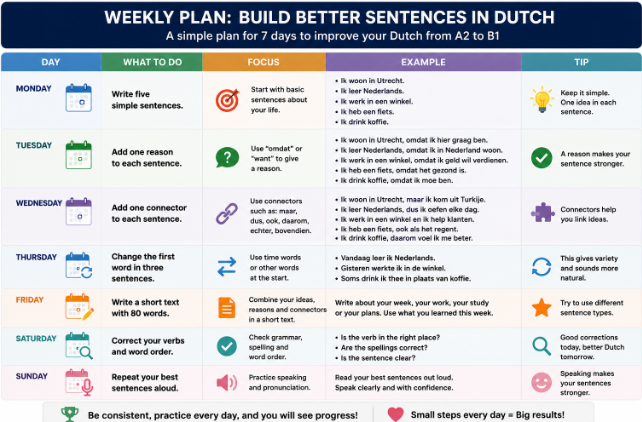
This plan builds confidence. In addition, it trains writing and speaking together. This method feels simple. However, it gives strong results over time.
Conclusion
Better sentences in Dutch help you move from A2 to B1 step by step. You do not need difficult grammar first. However, you need clear structure, good connectors, and enough detail. You should also use reasons, examples, and time words.
Start with one simple idea. Then add information. After that, add a reason. Because of this method, your Dutch becomes clearer and stronger.
Moreover, practice with real exam topics. Use feedback often. Check your verbs and word order every time. So, you will write and speak with more control.
If you want to prepare for Dutch exams, NT2 Oefening can support your practice. You can train all important skills and learn from feedback. Therefore, you can build better sentences in Dutch and feel more ready for B1.
Disclaimer:
This blog is for informational and awareness purposes only. The content can be verified from other sources. The author accepts no legal responsibility for any decisions made based on this information.